How to Remove Burnt Food From Titanium Cookware
Quick Answer
Start gentle: cool the pan, soak in warm water and dish soap, then use a sponge. Abrasive sponges are safe on Titan's uncoated surface; steel wool is safe on the frying pan. Repeat soaking rather than forcing.
Quick Method
- 1.Let the pan cool to a safe handling temperature — do not plunge a hot pan into cold water.
- 2.Fill with warm water and a little dish soap and soak for 30-60 minutes.
- 3.Clean with a sponge and dish soap; abrasive sponges are safe on Titan's uncoated surface.
- 4.For stubborn residue, soak longer and repeat rather than forcing.
- 5.For the frying pan, steel wool is safe if needed; for other pans, use abrasive sponges.
Start Gentle and Progress Slowly
The safest approach to burnt food is to start with the gentlest method and progress only if needed. Titan's uncoated titanium surface is durable and has no coating to damage, but that does not mean aggressive methods should be your first step. Patience and soaking will handle most burnt-on residue.
Step 1: Cool the Pan
Let the pan cool to a safe handling temperature before cleaning. Do not place a very hot pan directly into cold water. Sudden temperature changes can cause thermal shock, which may stress the cookware. The frying pan's care guidance specifically advises avoiding thermal shock. Let the pan cool on its own or on a cool part of the hob.
Step 2: Warm Water and Detergent Soak
Fill the pan with warm water and a small amount of dish soap. Let it soak for 30-60 minutes, or longer for stubborn residue. Soaking softens burnt-on food and makes it easier to remove without force.
Step 3: Gentle Cleaning
After soaking, clean with a sponge and dish soap. For most residue, this will be sufficient. Use a non-abrasive sponge first and see how much comes away.
Step 4: Abrasive Sponges (Verified for Titan)
If gentle cleaning does not remove the residue, you can use an abrasive sponge. Titan's care instructions confirm that abrasive sponges are safe — there is no coating to damage. For the frying pan specifically, steel wool is also listed as safe.
For the wok, sauté pan, and crepe pan, use abrasive sponges rather than steel wool unless you are confident. The frying pan's care instructions explicitly mention steel wool; the other products mention abrasive sponges.
Step 5: Repeat Rather Than Force
If residue still resists after scrubbing, soak the pan again — overnight if needed — and repeat. It is better to soak and repeat than to force or scrape aggressively. Burnt food will continue to soften with each soak.
Sugar, Honey and Marinade Residue
Sugar, honey, sweet sauces, and marinades can burn and polymerise into a hard, sticky layer that is more difficult to remove than ordinary food residue. These benefit from longer soaking in warm water. Avoid aggressive scraping, which can scratch the surface even though it will not damage the titanium itself.
For caramelised sugar, warm water and patience will eventually dissolve it. Do not use oven cleaner or harsh chemical descalers — these are not part of Titan's care guidance and may not be suitable for your product.
What to Avoid
Do not plunge a very hot pan into cold water — thermal shock can stress the cookware. Do not use oven cleaner, bleach, or harsh chemical descalers unless specifically confirmed as safe for your product. Do not use abrasive powders or scouring chemicals that are not part of Titan's care guidance.
The table below helps match the residue to the right approach.
| Residue Type | Recommended Approach | Notes |
|---|---|---|
| Light burnt food | Warm water soak + sponge | Usually sufficient after 30 minutes |
| Moderate burnt-on food | Warm water soak + abrasive sponge | Abrasive sponges are safe on all Titan cookware |
| Heavy burnt residue | Overnight soak + abrasive sponge; repeat | Repeat soaking rather than forcing |
| Caramelised sugar or honey | Warm water soak until dissolved | Avoid aggressive scraping; let water soften it |
| Polymerised oil film | Warm water soak + abrasive sponge | May require repeated soaking |
| Frying pan heavy residue | Warm water soak + steel wool | Steel wool is confirmed safe for the frying pan |
Frequently Asked Questions
Can I use baking soda to clean burnt food from my titanium pan?
Titan's care guidance does not specifically mention baking soda. Warm water, dish soap, and abrasive sponges are the recommended methods. If you wish to try baking soda, test on a small area first and rinse thoroughly.
Is it safe to put a hot pan in cold water to loosen burnt food?
No. Sudden temperature changes can cause thermal shock, which may stress the cookware. Let the pan cool first, then soak in warm water.
Can I use steel wool on my titanium pan?
Steel wool is confirmed safe for the frying pan. For the wok, sauté pan, and crepe pan, use abrasive sponges, which are confirmed safe for all Titan cookware.
Can I use Bar Keepers Friend or similar polish?
Titan's care guidance does not mention these products. We recommend warm water, dish soap, and abrasive sponges. If you wish to try a commercial polish, check that it is suitable for uncoated titanium and test on a small area first.
What if soaking does not remove the burnt food?
Soak longer — overnight if needed — and repeat. Burnt food will continue to soften with each soak. It is better to repeat than to force or scrape aggressively.
Related Products
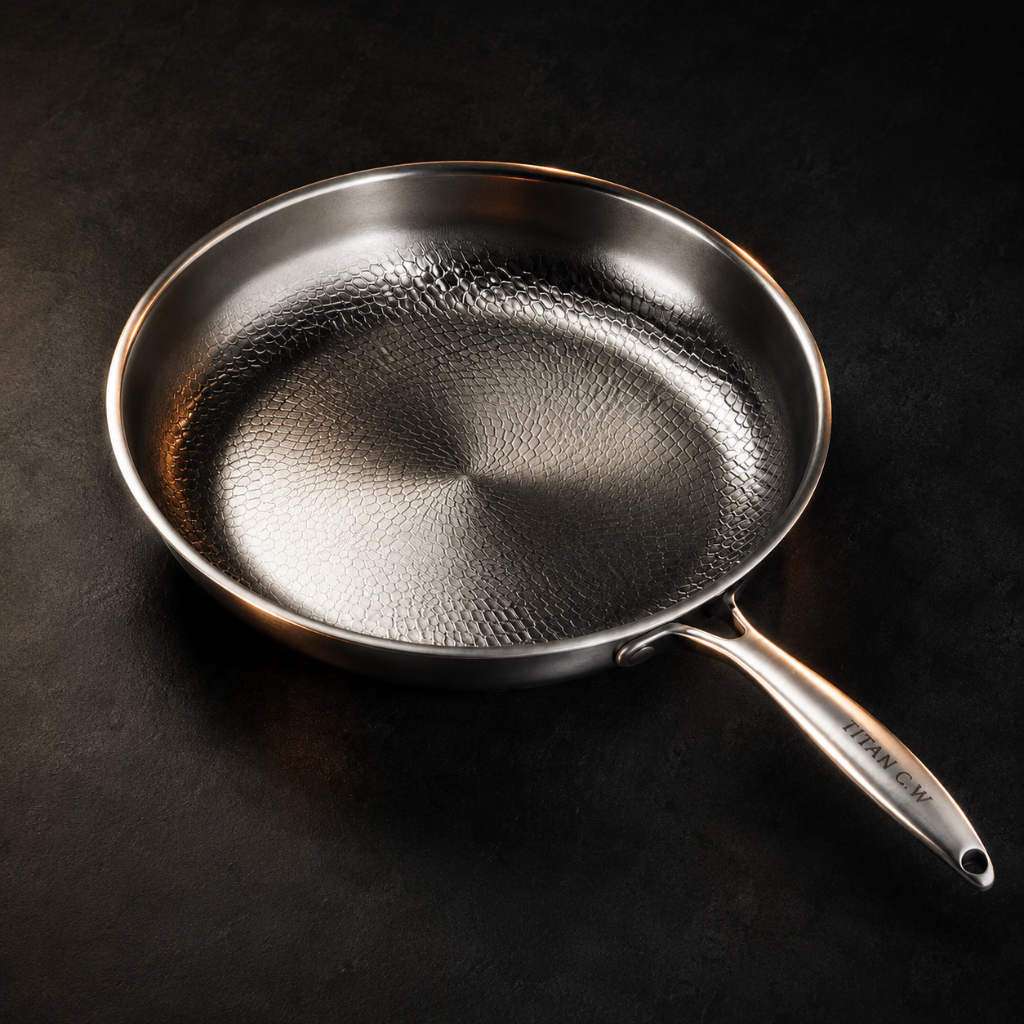
Titanium Frying Pan
A versatile titanium frying pan designed for everyday frying, searing and stovetop-to-oven cooking, with a durable cooking surface that does not rely on a traditional sprayed non-stick coating.

Titanium Wok
A high-sided titanium wok designed for stir-fries, noodles, fried rice and larger one-pan meals. The flat-base design is intended for use on compatible flat cooktops while the sloped sides give you room to toss, turn and move food.

Titanium Sauté Pan
A deeper titanium sauté pan designed for family meals, sauces, simmering and larger one-pan recipes. Two side handles make it easier to lift, carry and serve than a comparable long-handled pan.

Titanium Crepe Pan
A low-profile titanium pan designed for crepes, pancakes, eggs and flatbreads, with shallow edges that make it easier to reach, turn and slide delicate foods.
Related Guides
About the Author
Titan Cookwares Editorial Team