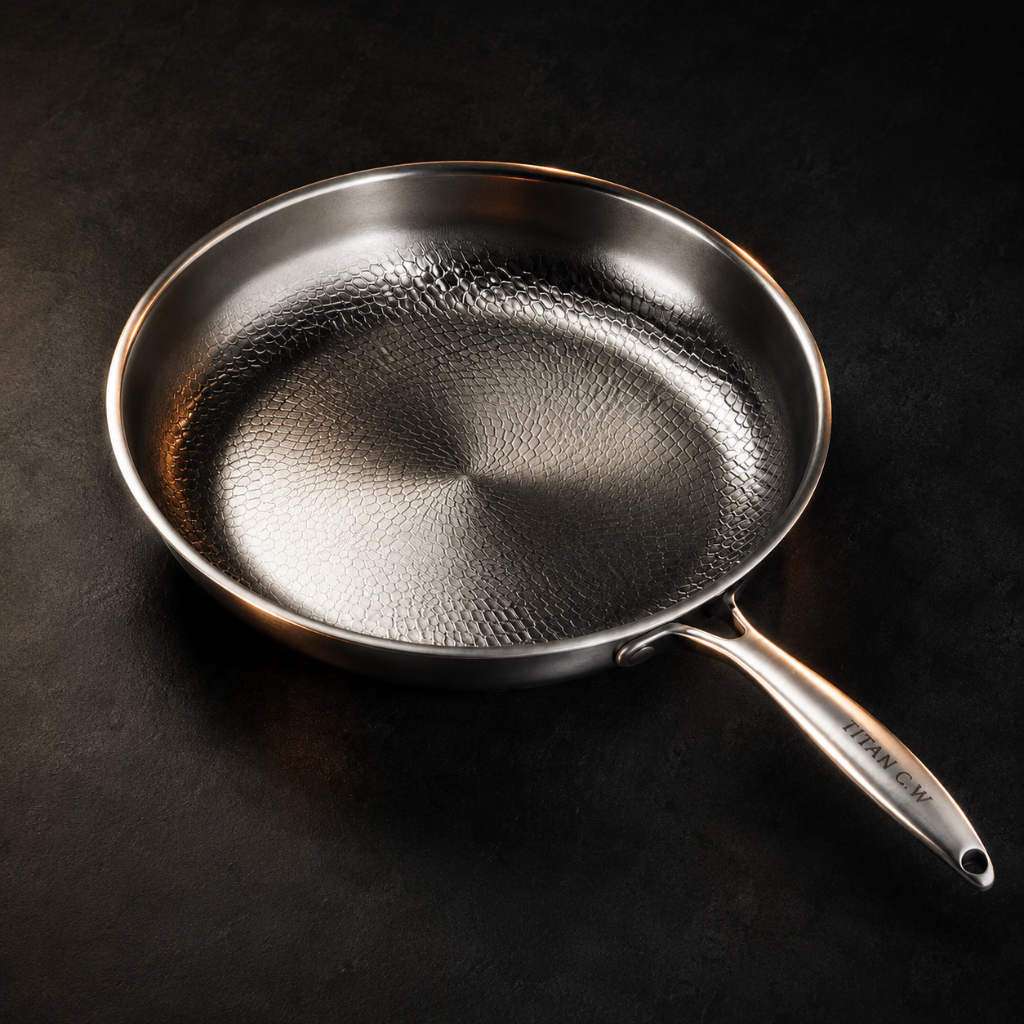

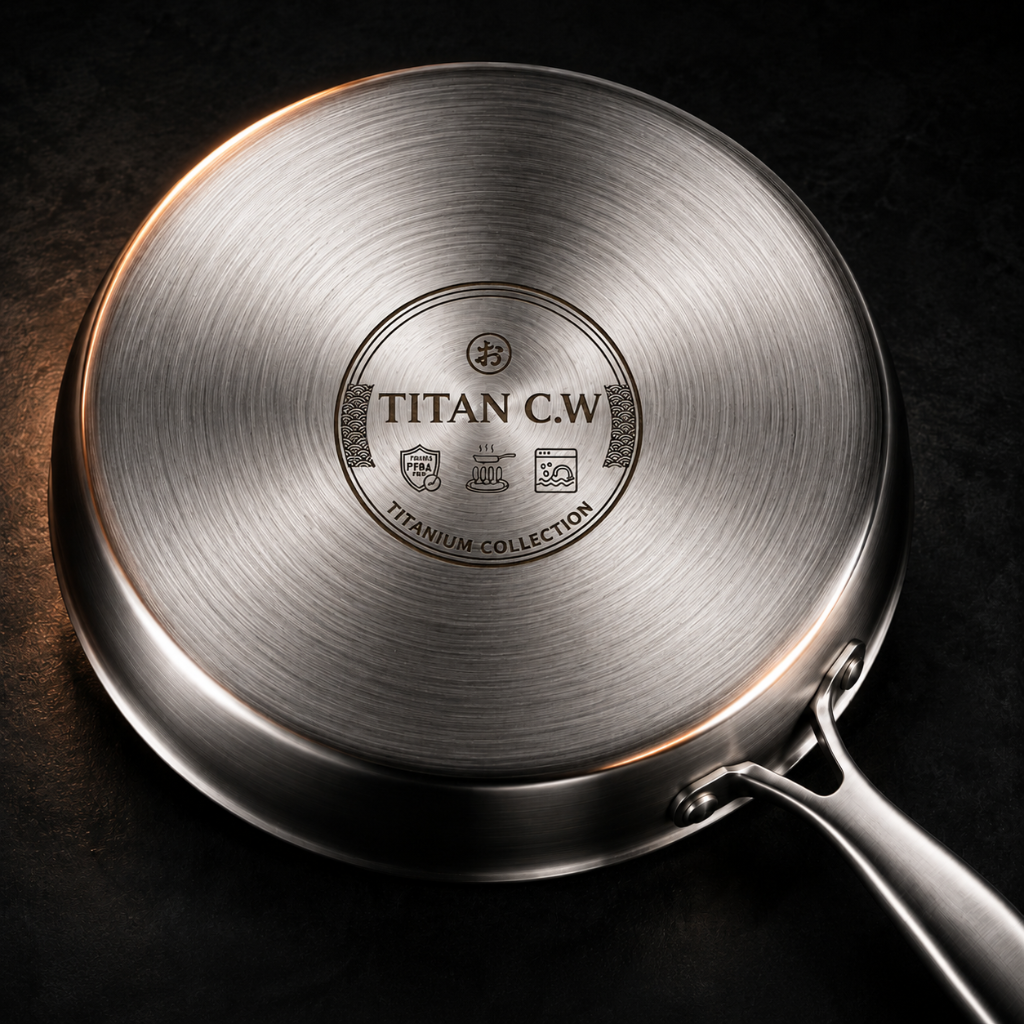
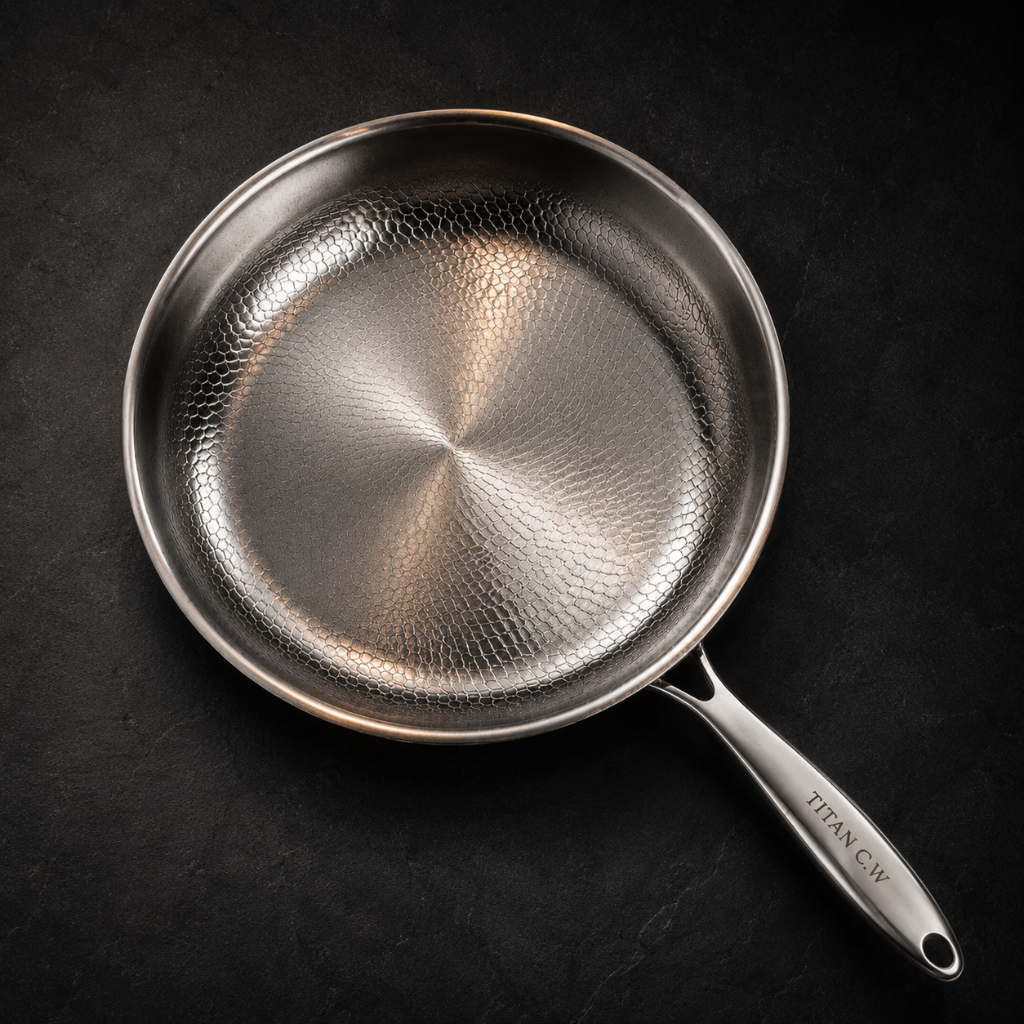
Hand-Hammered Titanium Frying Pan
Patented TITANIX PRO™ Technology
Professional inspiration. Everyday performance.
Oil Cooking Possibilities
For fitness-focused and everyday meals
Hotels Served Worldwide
Hospitality experience brought home
Added Non-Stick Coatings
A coating-free titanium cooking surface
Precision-Textured Surface
Distinctive hammered design
Limited Warranty
Designed for long-term cooking confidence
Save $90.00 today
Price Check
$117.64 less than HEALF today
Choose Your Set
Free titanium lid included with your pan
Choose Size
What's Included
- 1 × Hand-Hammered Titanium Frying Pan (chosen size)
- 1 × Getting Started With Titanium guide
- 25-year manufacturing warranty
Quick Answers
What to Expect
- —This is not a conventional PTFE-coated non-stick pan. Food release depends on heat, cooking fat and timing.
- —Surface colour changes may occur with use — this is normal for uncoated titanium and does not affect performance.
- —A short learning curve applies if you are used to coated non-stick cookware.
New to titanium cookware? Read our getting-started guide.
Why This Pan?
Your Everyday All-Rounder
The pan you reach for most. Sear, sauté, fry eggs, cook vegetables and finish one-pan meals — all on a single uncoated titanium surface that handles metal utensils and high heat without degrading.
Best For
- Everyday frying — eggs, vegetables, fish, and meat
- Searing at medium-high to high heat
- One-pan meals for 1–3 people
- Cooks transitioning from coated non-stick to uncoated cookware
Customer Reviews
The quality of the product is so great and I can't rave about it enough. You can tell that it was made with care and intention. I've switched to chemical free pots and pans so their product is perfect for what I prefer. It's been my go to every day pan.
Size: 10 in
— Sophia
Love the cookware! I have been waiting for something like this to be available. Lightweight, very durable. Great quality products.
— Andrea Chrisworth
The quality of the product is so great and I can�t rave about it enough. You can tell that it was made with care and intention. I�ve switched to chemical free pots and pans so their product is perfect for what I prefer. It�s been my go to every day pan.
— Lesley Thorne
The pan feels high quality and heats evenly, which made cooking a one-pan creamy chicken pasta really easy. I also appreciated how easy it was to clean afterward. Their collaboration team was friendly, responsive, and easy to work with. I�m looking forward to trying more recipes with it.
— Darryl Kennedy
I found Titan Cookwares in a Meta ad. I checked out the website and instantly fell in love with the solid titanium cookware. I showed it to my wife, and without even thinking, she said, "Buy it!" When I first placed my order, I was skeptical about the delivery time. It actually arrived quickly, within 11 days! The quality is amazing, and they seem very durable! I like the fact that Titan Cookwares guarantees their products for 25 years. They also clean up easily! If treated correctly, it may actually survive my wife using it, washing it, and leaving it in the sink to dry, like she has destroyed all my other pans! I plan on purchasing more Titan Cookwares high-quality cookware!
Size: 12 in
— Joseph Nadian
I LOVE Titan Cookwares !!! Excellent heat control, great searing performance, and a quality feel that stands out from the moment you pick it up. I've used my Titan Cookwares saut� pan for everything from butter basting steaks to preparing sauces, and it delivers consistent results every time. A well-crafted piece of cookware built for serious home cooks and chefs alike.
— Laura Hitching
Excellent cook ware but packaging was terrible. Bolts come loose in the box. Feels great and is lightweight. We will see over time the quality of the product
Size: 10 in
— Claire
Took a while to arrive, but when they did, put a smile on my wife's face. High quality, high function, lifetime product. Worth it. Have ordered more.
— Jerry Mead
Best quality products and very responsible staff. Product came fast and safely!
— James Smith
I bought this over labor day so it did take a little over a week to get to me. I love that the pan is not to heavy. I use my fry pans daily. It is very easy to clean after use. You may need to soak it for a bit if you make something that sticks. So far I am loving this new skillet. I have regular stainless steel pans now and this skillet is much nicer than my current pans. I really like the quality of this pan.
— Jason Triail
The quality of the product is so great and I can't rave about it enough. You can tell that it was made with care and intention. I've switched to chemical free pots and pans so their product is perfect for what I prefer. It's been my go to every day pan.
Size: 10 in
— Sophia
Love the cookware! I have been waiting for something like this to be available. Lightweight, very durable. Great quality products.
— Andrea Chrisworth
The quality of the product is so great and I can�t rave about it enough. You can tell that it was made with care and intention. I�ve switched to chemical free pots and pans so their product is perfect for what I prefer. It�s been my go to every day pan.
— Lesley Thorne
The pan feels high quality and heats evenly, which made cooking a one-pan creamy chicken pasta really easy. I also appreciated how easy it was to clean afterward. Their collaboration team was friendly, responsive, and easy to work with. I�m looking forward to trying more recipes with it.
— Darryl Kennedy
I found Titan Cookwares in a Meta ad. I checked out the website and instantly fell in love with the solid titanium cookware. I showed it to my wife, and without even thinking, she said, "Buy it!" When I first placed my order, I was skeptical about the delivery time. It actually arrived quickly, within 11 days! The quality is amazing, and they seem very durable! I like the fact that Titan Cookwares guarantees their products for 25 years. They also clean up easily! If treated correctly, it may actually survive my wife using it, washing it, and leaving it in the sink to dry, like she has destroyed all my other pans! I plan on purchasing more Titan Cookwares high-quality cookware!
Size: 12 in
— Joseph Nadian
I LOVE Titan Cookwares !!! Excellent heat control, great searing performance, and a quality feel that stands out from the moment you pick it up. I've used my Titan Cookwares saut� pan for everything from butter basting steaks to preparing sauces, and it delivers consistent results every time. A well-crafted piece of cookware built for serious home cooks and chefs alike.
— Laura Hitching
Excellent cook ware but packaging was terrible. Bolts come loose in the box. Feels great and is lightweight. We will see over time the quality of the product
Size: 10 in
— Claire
Took a while to arrive, but when they did, put a smile on my wife's face. High quality, high function, lifetime product. Worth it. Have ordered more.
— Jerry Mead
Best quality products and very responsible staff. Product came fast and safely!
— James Smith
I bought this over labor day so it did take a little over a week to get to me. I love that the pan is not to heavy. I use my fry pans daily. It is very easy to clean after use. You may need to soak it for a bit if you make something that sticks. So far I am loving this new skillet. I have regular stainless steel pans now and this skillet is much nicer than my current pans. I really like the quality of this pan.
— Jason Triail
Product Highlights
No Traditional Non-Stick Coating
The cooking surface is the titanium itself
Induction Compatible
Works on induction cooktops
Oven Safe
Can be used in the oven
Metal-Utensil Friendly
No coating to scratch
Dishwasher Safe
Easy to clean
Hand-Hammered
Textured surface for heat distribution
The Everyday Pan You'll Reach for Most
If you're adding one piece of titanium cookware to your kitchen, the frying pan is the most versatile place to start. It handles the everyday tasks that most kitchens rely on a pan for: frying eggs, searing meat, sautéing vegetables, cooking fish, reheating leftovers, and making quick pan sauces.
The flat base and curved walls make it suitable for a wide range of cooking — from breakfast pancakes to weeknight one-pan meals. It moves from cooktop to oven when a recipe calls for finishing under heat, and the titanium surface doesn't rely on a sprayed coating that wears off over time.
It's not the right tool for every technique. High-volume stir-frying is better suited to the Titan Wok, with its deeper walls and tossing shape. Large-batch sauces and family-size meals may be a better fit for the Titan Sauté Pan.
But for the pan you'll use most days — the one that sits on the hob ready for breakfast, lunch, or dinner — the frying pan is the one to choose.
How Titanium Food Release Works
An uncoated titanium surface doesn't behave the same way as a fresh PTFE-coated non-stick pan. It doesn't rely on a chemical layer to prevent sticking. Instead, food release depends on heat control and cooking technique.
When the pan is preheated correctly and food is added at the right temperature, proteins naturally release from the titanium surface once they've formed a crust. This is the same principle that works on stainless steel — the surface isn't inherently "non-stick," but it releases food when used correctly.
For many foods, a small amount of cooking fat helps create a layer between the food and the surface. Eggs, fish, and delicate items benefit from this. Foods with higher fat content — bacon, sausages — may need less added fat.
Titanium cookware can provide effective food release when used with suitable heat control and cooking technique, but an uncoated titanium surface should not be expected to behave exactly like a fresh PTFE-coated non-stick pan.
Getting the Best Results From Your Titanium Pan
A few simple techniques will help you get the most out of your frying pan.
Preheat Gently
Start with low-to-medium heat. Titanium conducts heat efficiently, so high heat is rarely necessary. Give the pan a minute or two to warm up before adding anything.
Add Cooking Fat
A small amount of oil or butter is often enough. The amount depends on what you're cooking — eggs and fish benefit from a thin coating; fatty meats may need less.
Add Food at the Right Time
Wait until the pan is properly preheated. A drop of water should bead and roll — not sizzle and evaporate instantly. Add food when the fat is hot but not smoking.
Let the Food Release
Don't force it. If food resists when you try to move it, it usually needs more time. Once a crust forms, proteins will release from the surface on their own.
Clean After Cooling
Let the pan cool before washing. Sudden temperature changes can affect the metal. Wash with warm water and mild detergent. Abrasive sponges are safe — there's no coating to damage.
What This Pan Is Good For
Breakfast
Eggs, pancakes, bacon, breakfast vegetables
Weeknight Cooking
Chicken, fish, sautéed vegetables, quick dinners
Searing
Steak, pork chops, scallops — when browning matters
One-Pan Meals
Rice dishes, skillet dinners, reheating leftovers
Specifications
| Product Type | Frying Pan |
| Material | Solid titanium (uncoated) |
| Construction | Hand-hammered solid titanium |
| Surface | Hand-hammered titanium |
| Handle | Titanium |
| Cooktop Compatibility | Gas, Electric, Ceramic, Induction, Oven, Grill, Campfire |
| Induction Compatible | Yes |
| Oven Compatible | Yes |
| Maximum Temperature | 1000°F / 540°C |
| Dishwasher | Yes — dishwasher-safe |
| Metal Utensils | Yes — no coating to scratch |
| Warranty | 25 years against manufacturing defects |
Product Type
Frying Pan
Material
Solid titanium (uncoated)
Construction
Hand-hammered solid titanium
Surface
Hand-hammered titanium
Handle
Titanium
Cooktop Compatibility
Gas, Electric, Ceramic, Induction, Oven, Grill, Campfire
Induction Compatible
Yes
Oven Compatible
Yes
Maximum Temperature
1000°F / 540°C
Dishwasher
Yes — dishwasher-safe
Metal Utensils
Yes — no coating to scratch
Warranty
25 years against manufacturing defects
Why Titanium for a Frying Pan?
Titanium is valued in cookware for its durability, corrosion resistance, and relatively light weight. It doesn't react with acidic foods, and it doesn't require a sprayed non-stick coating to function as a cooking surface.
The cooking surface is the titanium itself. There's no chemical layer to scratch, wear off, or degrade over time. Metal utensils can be used without damaging a coating, and the pan can go in the dishwasher without concern for a coating's integrity.
For a frying pan — one of the most frequently used pieces in any kitchen — these characteristics matter. A pan that gets daily use benefits from a surface that doesn't wear out with normal cooking and cleaning.
Titanium vs Coated Non-Stick
A balanced comparison — each has its strengths.
| Titan Frying Pan | Conventional Coated Non-Stick | |
|---|---|---|
| Surface Type | Hand-hammered titanium (no sprayed coating) | PTFE-based sprayed coating |
| Cooking Technique | May require more heat and fat management | Typically more forgiving for low-stick cooking when new |
| Metal Utensils | Safe — no coating to scratch | Can damage the coating; silicone or wood recommended |
| High-Heat Suitability | Suitable for high-heat searing | High heat can degrade the coating over time |
| Coating Wear | No coating to wear off | Coating wears with use; typically replaced every 2–3 years |
| Cleaning | Dishwasher-safe; abrasive sponges safe | Hand-wash recommended; no abrasive cleaners |
| Expected Ownership | Designed for long-term use | Typically replaced every few years |
Is the Frying Pan Right for You?
Each Titan pan has a different strength. Here's how they compare.
What's Included
- 1 × Hand-Hammered Titanium Frying Pan (chosen size)
- 1 × Matching titanium-rim glass lid
- 1 × Getting Started With Titanium guide
- 25-year manufacturing warranty
Care for Your Titanium Frying Pan
Before First Use
Wash the pan with warm water and mild dish soap. Dry thoroughly. Your pan is ready to use — no seasoning is required.
Everyday Cleaning
Hand-wash with warm water and dish soap. Abrasive sponges and steel wool are safe — there is no coating to damage. The pan is also dishwasher-safe.
Stuck-On Food
Soak in warm water for a few minutes. For stubborn residue, use an abrasive sponge or steel wool. A paste of baking soda and water can help with stubborn spots.
Discolouration
Titanium can develop heat tint (a subtle colour change) with use. This is cosmetic and does not affect cooking performance. It can be cleaned with a mild abrasive cleaner if desired.
Utensils
Metal utensils are safe — there is no coating to scratch. Silicone, wood, and plastic utensils are also fine.
Storage
Stack with care. If stacking pans inside each other, a soft cloth or pan protector between them prevents scratching of the exterior finish.
Heat Control
Use low-to-medium heat for most cooking. Titanium conducts heat efficiently, so high heat is rarely necessary. Avoid sudden temperature changes (e.g., placing a hot pan under cold water).
Shipping
Estimated dispatch: 2 working days – 4 working days
Estimated delivery: 3 working days – 7 working days
Free standard shipping. Insured & priority options at checkout.
Full details


Buying More Than One Piece?
Choose the frying pan, wok, sauté pan, crepe pan and prep pieces that fit the way you cook.
Build Your SetLearn More
What Size Frying Pan Should I Buy?
Titan offers the frying pan in 10 in / 26 cm and 12 in / 30 cm. Choose 10 in for one to two people and everyday cooking; choose 12 in for larger meals and batch cooking. The right size depends on your household, hob and the meals you cook most often.
Read GuideCrepe Pan vs Frying Pan: Which One Do You Need?
A crepe pan has a very low rim for easy flipping of crepes, pancakes and flatbreads; a frying pan has higher walls for general cooking, searing and liquid containment. For most cooks buying one pan first, a frying pan is the more versatile choice — but a crepe pan is worth adding if you cook flat foods regularly.
Read GuideFrying Pan vs Wok: Which Should You Choose?
Choose a frying pan for general everyday versatility — searing, eggs, vegetables and one-pan meals. Choose a wok when high sloped walls and ingredient movement matter more — stir-fries, noodles and large-batch tossing. Neither replaces the other entirely.
Read GuideFrequently Asked Questions
Product Questions & Answers
Factual answers about Hand-Hammered Titanium Frying Pan — materials, sizes, compatibility and care.
What is this product made from?
Solid titanium (uncoated). Hand-hammered solid titanium. Uncoated solid titanium — no PTFE, PFOA, or chemical non-stick coating.
What sizes are available?
10", 12"
What is included?
1 × Hand-Hammered Titanium Frying Pan (chosen size), 1 × Matching titanium-rim glass lid, 1 × Getting Started With Titanium guide, 25-year manufacturing warranty.
Is it coated?
No. The cooking surface is uncoated solid titanium with no chemical non-stick layer.
Which cooktops does it support?
Gas, Electric, Ceramic, Induction, Oven, Grill, Campfire. Induction compatible.
Is it oven safe?
Yes, it is oven safe. Maximum oven temperature: 1000°F / 540°C.
How should it be cleaned?
Yes — dishwasher-safe Yes — no coating to scratch Wash with warm water and dish soap. Abrasive sponges and steel wool safe. Dishwasher-safe. Avoid thermal shock.
What is the shipping time?
Dispatch: 2 working days–4 working days. Delivery: 3 working days–7 working days.
What is the return policy?
14-day return window from delivery. See our Returns page for details.
What warranty is included?
25 years against manufacturing defects
Hand-Hammered Titanium Frying Pan
$59.99
Current Batch