The Complete Titanium Cookware Material Guide
Quick Answer
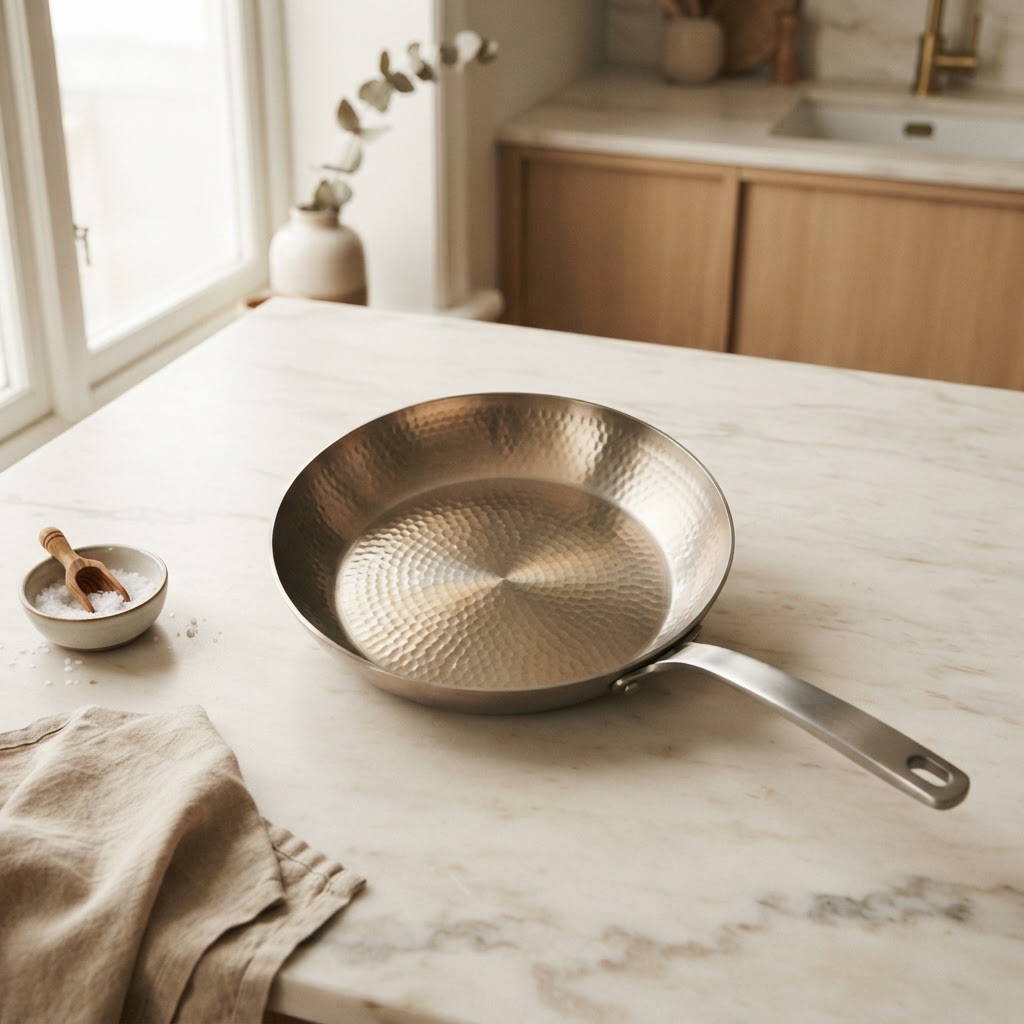
Titanium cookware is cookware made from titanium — a durable, corrosion-resistant, biocompatible metal. Uncoated solid titanium has no synthetic coating (no PFAS, PTFE, or PFOA), does not degrade over time, and can last a lifetime with proper care. This guide explains the different titanium constructions, how titanium compares to other cookware materials, how food release works, and what to consider when buying.
What Titanium Cookware Means
Titanium cookware is cookware made from titanium — a transition metal known for its high strength-to-weight ratio, corrosion resistance, and chemical inertness. In the context of cookware, "titanium" can mean several different things, and understanding the distinction matters when choosing a pan.
The most important distinction is between uncoated solid titanium cookware, where the cooking surface is the titanium metal itself, and titanium-reinforced coated cookware, where a thin layer of titanium is added to a conventional non-stick coating or an aluminium core. This guide focuses primarily on uncoated solid titanium cookware, which is what Titan Cookwares produces.
Titanium (chemical symbol Ti, atomic number 22) has been used in medical implants, aerospace applications, and food processing equipment for decades because of its biocompatibility and resistance to corrosion. These same properties make it well-suited to cookware.
Different Titanium Cookware Constructions
Not all products marketed as "titanium cookware" are constructed the same way. The main constructions are:
Uncoated solid titanium: The entire pan body, including the cooking surface, is made from titanium. There is no sprayed coating, no aluminium core exposed to food, and no synthetic non-stick layer. This is the construction Titan Cookwares uses. The cooking surface is the metal itself.
Titanium-reinforced non-stick: A conventional PTFE-based non-stick coating with titanium particles added for durability. The cooking surface is still a synthetic coating — the titanium improves wear resistance but does not eliminate the coating. These pans behave like conventional non-stick, not like solid titanium.
Titanium-coated aluminium: A thin layer of titanium is applied over an aluminium core. This reduces weight and cost but the titanium layer can wear through over time, exposing the aluminium beneath. These are sometimes marketed as "titanium pans" but are not solid titanium.
If your priority is avoiding coatings entirely, look for products that explicitly state the pan is made from solid or uncoated titanium throughout — not just a titanium-infused coating.
Uncoated Titanium: How It Works
Uncoated titanium cookware works differently from coated non-stick. The cooking surface is bare metal, which means food release depends on technique rather than a chemical layer. Proper preheating and a small amount of oil or fat are part of the cooking method.
When a titanium pan is properly preheated and lightly oiled, proteins form a crust and release naturally as they cook — the same principle as cooking on stainless steel or carbon steel. This is not the same as the effortless release of a brand-new PTFE coating, but it is consistent: the surface behaves the same way on day one as it does after years of use because there is no coating to degrade.
The key skills are preheating the pan before adding food, using enough oil or fat to coat the surface, and allowing food to develop a crust before trying to move it. Once these become habit, titanium cookware performs reliably across a wide range of dishes.
Titanium vs Stainless Steel Cookware
Both titanium and stainless steel are durable, coating-free metals, but they behave differently. Titanium is lighter — a titanium frying pan weighs noticeably less than a stainless steel pan of the same size. Titanium is also more corrosion-resistant and does not react with acidic foods like tomato or citrus. Stainless steel, particularly tri-ply construction with an aluminium core, generally offers more even heat distribution and faster temperature response.
For cooks who prioritise a coating-free surface with maximum durability and light weight, titanium is the better choice. For cooks who prioritise heat responsiveness and even distribution, stainless steel tri-ply may be preferable. Many cooks own both and use each for different purposes.
For a detailed comparison, see our guide on [titanium vs stainless steel cookware].
Titanium vs Aluminium Cookware
Aluminium is an excellent heat conductor — better than titanium — which is why it is used as a core material in much high-end cookware. However, bare aluminium is soft, can react with acidic foods, and is not ideal as a cooking surface on its own. Anodised aluminium and aluminium with non-stick coatings address these issues but introduce their own considerations.
Titanium is a poorer heat conductor than aluminium, which means titanium pans can have more hot spots if the construction does not account for this. However, titanium is harder, more durable, and completely inert. The trade-off is heat responsiveness (aluminium wins) versus surface durability and chemical inertness (titanium wins).
Heat Behaviour of Titanium Cookware
Titanium has lower thermal conductivity than aluminium or copper, which means it takes slightly longer to heat up and the heat may be less evenly distributed across the surface. In practice, this means preheating is important — give the pan a moment to come to temperature before adding food.
Once hot, titanium holds heat well. It is suitable for searing, stir-frying, and high-heat cooking. The key is to let the pan preheat properly rather than rushing. For temperature-sensitive cooking, the learning curve is understanding how the pan responds to burner changes, which is slightly slower than aluminium-core pans.
Food Release on Uncoated Titanium
Food release on uncoated titanium is technique-dependent, not coating-dependent. With proper preheating and oil, most foods release cleanly. Eggs, a common test, work well once the pan is hot and oiled — but they require the right technique, which is different from simply pouring them into a cold non-stick pan.
The advantage of technique-based food release is consistency: because the surface never changes, the food release you experience does not degrade over time. A pan that releases eggs well on day one will release eggs well after five years, because there is no coating to wear off. See our guide on [how to prevent food sticking to titanium] for the full method.
Care and Cleaning
Titanium cookware is low-maintenance. Because there is no coating, you can use metal utensils, abrasive sponges, and scrubbing pads without damaging the surface. Burnt-on food can be removed with a baking soda paste or by simmering water in the pan. Most titanium cookware is dishwasher-safe, though hand-washing is recommended to maintain the surface appearance.
Titanium can develop a patina or heat discolouration over time — this is normal oxidation and does not affect performance. It can be polished away if desired, but many cooks consider it a natural characteristic of the metal. See our guide on how to clean titanium cookware for detailed instructions.
Advantages of Titanium Cookware
No coatings to wear off: The cooking surface is solid metal, so there is no PTFE, PFAS, or other synthetic coating to scratch, degrade, or peel into food.
Durability: Titanium is extremely hard and corrosion-resistant. With proper care, a titanium pan can last a lifetime.
Biocompatibility: Titanium is inert and does not react with acidic or alkaline foods. It is the same metal used in medical implants.
Light weight: Titanium is lighter than stainless steel of comparable strength, making the pans easier to handle.
Metal utensils: Because there is no coating, metal utensils will not damage the cooking surface.
Warranty: Quality titanium cookware is typically backed by long warranties — Titan Cookwares offers 25 years against manufacturing defects.
Limitations of Titanium Cookware
Learning curve: Uncoated titanium requires preheating and oil for good food release. Cooks used to coated non-stick may need time to adjust their technique.
Heat distribution: Titanium has lower thermal conductivity than aluminium or copper. Without a core layer, heat distribution may be less even than tri-ply stainless steel.
Price: Solid titanium is an expensive material. Quality titanium cookware costs more than most coated non-stick alternatives.
Not "non-stick" in the PTFE sense: Uncoated titanium is not a drop-in replacement for coated non-stick. It is a different cooking method that produces consistent results once learned.
Safety Terminology: PFAS, PTFE, and PFOA
PFAS (per- and polyfluoroalkyl substances) is a family of synthetic chemicals that includes PTFE (polytetrafluoroethylene), the material used in traditional non-stick coatings. PFOA (perfluorooctanoic acid) was a processing aid historically used in PTFE production and has largely been phased out.
Uncoated solid titanium cookware does not contain PFAS, PTFE, or PFOA because it has no synthetic coating at all. The cooking surface is the metal itself. This is distinct from titanium-reinforced non-stick cookware, which still uses a PTFE-based coating with titanium particles added.
When a product claims to be "PFAS-free," check whether it is uncoated or simply uses a different coating. "PFAS-free" does not necessarily mean coating-free. For more on this, see our guide on [PFAS-free cookware what buyers should know].
Buying Considerations
When choosing titanium cookware, consider the following:
Construction: Is it solid uncoated titanium, titanium-reinforced non-stick, or titanium-coated aluminium? The construction determines how the pan behaves and how long it lasts.
Cooktop compatibility: Pure titanium is not magnetic, so induction compatibility depends on whether the pan has a magnetic base layer. Check the specifications for your cooktop.
Warranty: A long warranty (10+ years) indicates the manufacturer stands behind the product. Titan Cookwares offers 25 years.
Size: Choose a size that matches how you cook. A 10-inch pan suits 1–2 people; a 12-inch pan suits families. See our guide on what size frying pan to buy.
Set vs individual pieces: If you cook a variety of dishes, consider building a set. Our build your own titanium set tool lets you choose pieces and sizes individually.
Frequently Asked Questions
Is titanium cookware the same as titanium non-stick?
No. Solid titanium cookware has no coating — the cooking surface is the metal itself. Titanium non-stick (or titanium-reinforced non-stick) uses a PTFE coating with titanium particles added. They cook differently and have different lifespans.
Does titanium cookware contain PFAS or PTFE?
Uncoated solid titanium cookware does not contain PFAS, PTFE, or any synthetic coating. If a product is marketed as "titanium non-stick," check whether it uses a coating — many do.
Is titanium cookware better than stainless steel?
Neither is universally better. Titanium is lighter, more corrosion-resistant, and has no coating to wear off. Stainless steel (particularly tri-ply) offers better heat distribution and responsiveness. Many cooks own both.
How long does titanium cookware last?
With proper care, solid titanium cookware can last a lifetime. Because there is no coating to degrade, the cooking surface does not change over time. Titan Cookwares backs its products with a 25-year warranty.
Can titanium cookware go in the dishwasher?
Most titanium cookware is dishwasher-safe because there is no coating to damage. However, hand-washing is recommended to maintain the surface appearance. Check the manufacturer guidance for your specific pan.
References
- Titanium — PubChem, National Library of Medicine — NIH (accessed October 5, 2026)
- Per- and Polyfluoroalkyl Substances (PFAS) — EPA (accessed October 5, 2026)
Last fact-checked October 5, 2026
Related Products
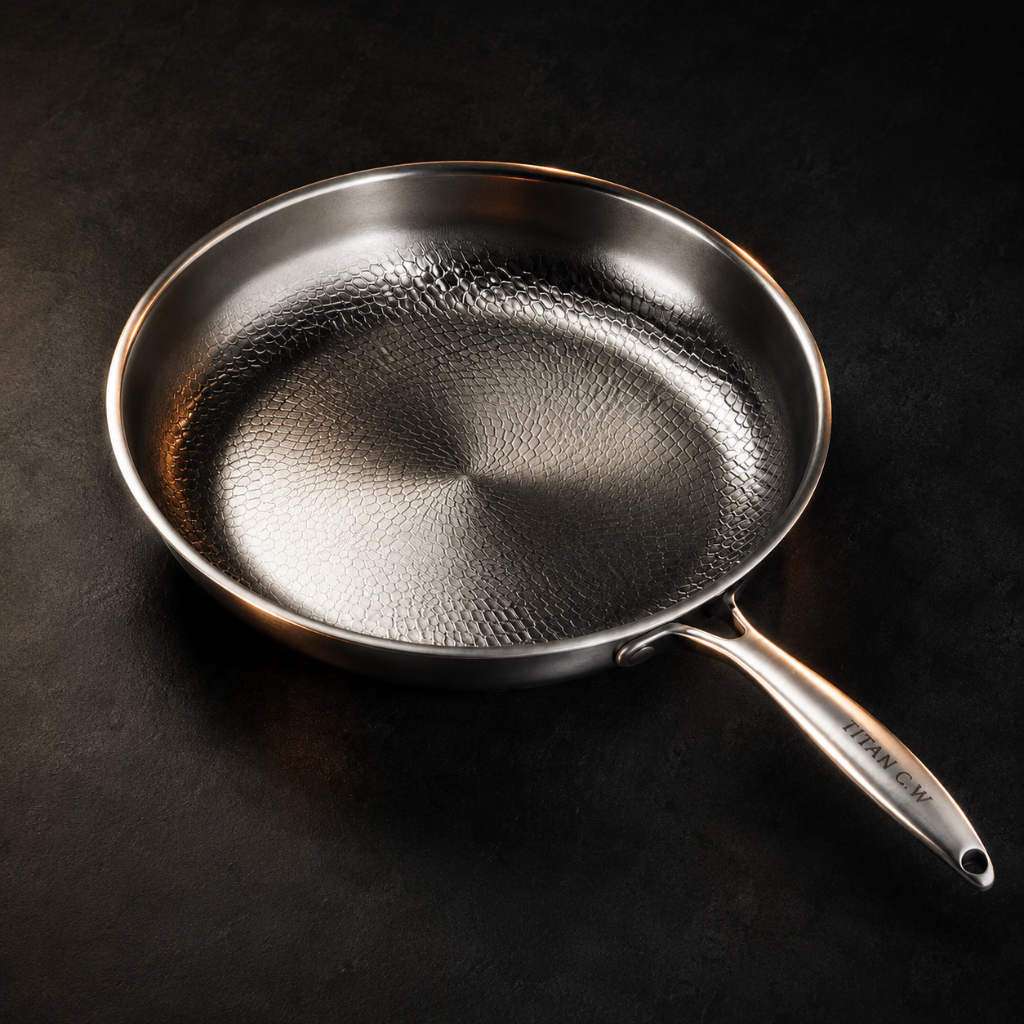
Titanium Frying Pan
A versatile titanium frying pan designed for everyday frying, searing and stovetop-to-oven cooking, with a durable cooking surface that does not rely on a traditional sprayed non-stick coating.

Titanium Wok
A high-sided titanium wok designed for stir-fries, noodles, fried rice and larger one-pan meals. The flat-base design is intended for use on compatible flat cooktops while the sloped sides give you room to toss, turn and move food.

Titanium Sauté Pan
A deeper titanium sauté pan designed for family meals, sauces, simmering and larger one-pan recipes. Two side handles make it easier to lift, carry and serve than a comparable long-handled pan.

Titanium Crepe Pan
A low-profile titanium pan designed for crepes, pancakes, eggs and flatbreads, with shallow edges that make it easier to reach, turn and slide delicate foods.

Cutting Board
A durable titanium food-preparation surface designed for chopping, slicing and everyday kitchen prep, with a non-porous construction that is easy to clean and maintain.
Build Your Own Titanium Set
Choose your pieces, select your sizes and create a titanium cookware set that fits the way you cook.
Build Your SetRelated Guides
Titanium vs Stainless Steel Cookware
Stainless steel conducts heat better and is generally less expensive, while titanium is lighter, more durable, and completely free of coatings. Both are inert and safe for acidic foods. The right choice depends on your priorities: even heating and value favour stainless steel; light weight and lifetime durability favour titanium.
Titanium vs Ceramic Cookware
Ceramic cookware offers good non-stick performance out of the box but the coating typically degrades after 1–3 years. Titanium has no coating to degrade and can last decades, but requires more technique for food release. If you want effortless non-stick, ceramic is easier short-term; if you want a lifetime pan, titanium is the better investment.
Is Titanium Cookware Safe?
Titanium cookware is widely considered safe for cooking. Titanium is biocompatible — it is used in medical implants and dental fixtures — and uncoated titanium pans do not require PFAS, PTFE, or other synthetic coatings that can raise health concerns. The main consideration is buying from a reputable manufacturer, since quality varies.
Titanium Cookware Pros and Cons
Titanium cookware is extremely durable, lightweight, and free of synthetic coatings. The main drawbacks are price (solid titanium is expensive), a learning curve for food release, and the fact that titanium does not conduct heat as evenly as aluminium or copper. For most cooks, the trade-offs are worth it; for others, they may not be.
About the Author
Titan Cookwares Editorial Team